
How does the verification of compression perpendicular to grain change with the new Eurocode 5?
EN 1995-1-1:2025 introduces a new stress-spreading model and a verification approach that accounts for the acceptable level of deformation under specific design conditions, as well as the mechanical properties of different wood-based products.
These changes are among the new verification procedures we are currently implementing in TimberTech Buildings, in preparation for the upcoming update to the second-generation Eurocodes.
Below, we explore the main changes, focusing on compression perpendicular to grain in timber-frame walls and presenting a comparative example illustrating the results obtained using the previous and the new Eurocode 5.
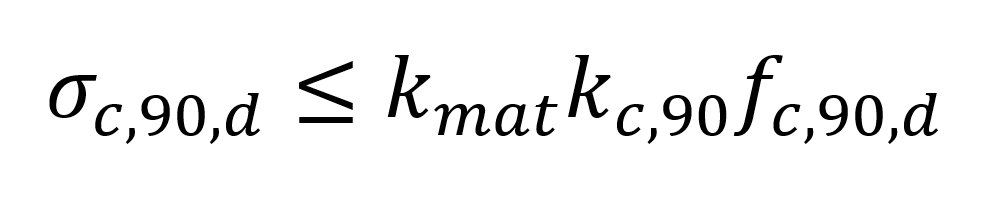
The new verification procedure, described in Clause 8.1.6, requires the following condition to be satisfied:
Stress spreading and the kc,90 factor
Unlike the previous formulation, EN 1995-1-1:2025 introduces a calculation model that accounts for the spreading of compressive stresses beyond the directly loaded area, through the definition of an effective spreading area depending on the member geometry and support conditions.
For solid timber and glued laminated timber members, stress spreading occurs at different angles relative to the grain direction: 45° parallel to grain and 15° perpendicular to grain.
The stress-spreading factor is determined from the loaded area (A) and the effective spreading area (Aef):
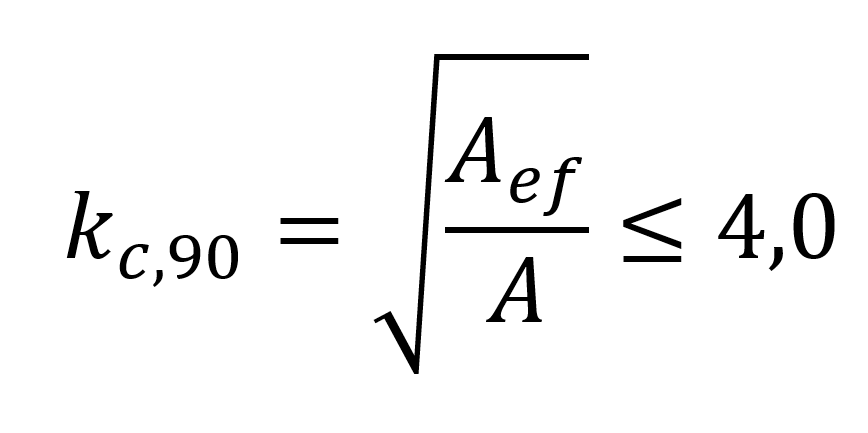
The effective spreading area depends on the member geometry, the dimensions of the loaded area and the support conditions, also accounting for limitations to stress spreading due to nearby loads or member ends.
The new kmat factor
Another important change is the introduction of the kmat, factor, which accounts for the different behaviour of wood-based products subjected to compression perpendicular to grain.
A particularly significant aspect of the new formulation is the distinction between three acceptable deformation levels which, for solid timber and glued laminated timber members, determine different values of kmat
depending on the consequences of deformation for structural stability:
- kmat=1,4: when deformation may compromise stability or cause damage to other structural components.
- kmat=2,1: when deformation has no significant effect on structural stability.
- kmat=2,7: when deformation does not compromise stability and local failure can be accepted without affecting the overall structure.
In the upcoming version of TimberTech Buildings, designers will be able to select the acceptable deformation level directly in the wall-type definition, allowing the software to apply the corresponding factor in the verification.
Calculation Example: Comparison Between the Previous and New Eurocode 5
To highlight the impact of the introduc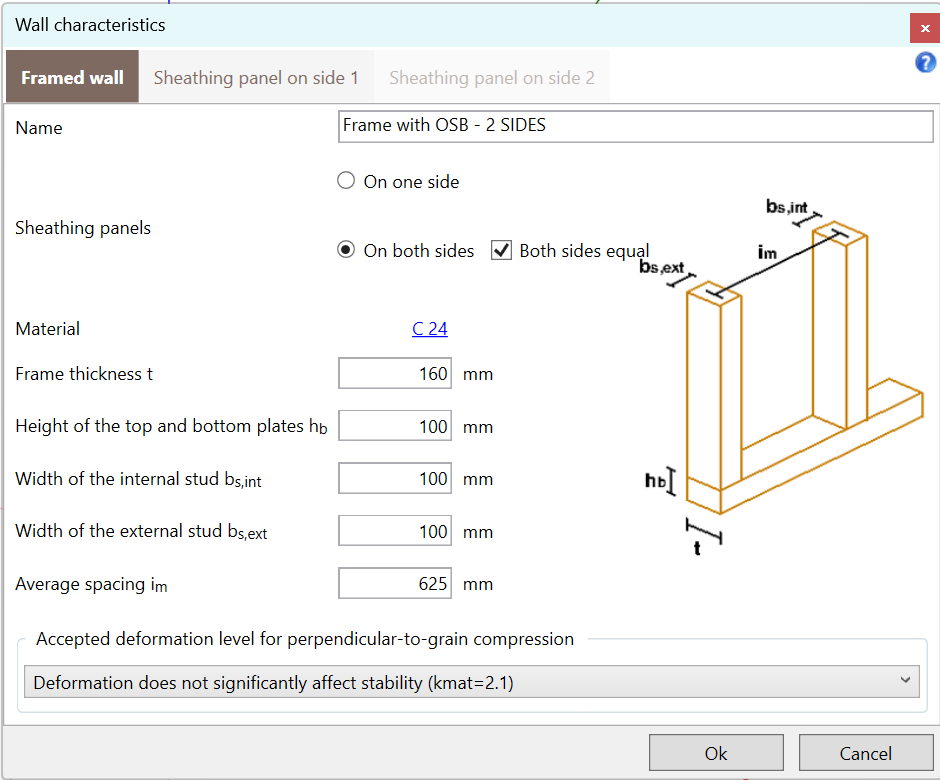 ed changes, we present an example of compression perpendicular to grain verification for the top and bottom plates of a timber-frame wall, analysing the same structural configuration under three different cases:
- Case 1 – EN 1995-1-1:2014: verification according to the previous Eurocode 5.
- Case 2 – EN 1995-1-1:2025, (kmat=1,4): verifica secondo il nuovo Eurocodice 5, considerando il caso in cui le deformazioni possono compromettere la stabilità di altri componenti.
- Case 3 – EN 1995-1-1:2025, (kmat=2,1): verification according to the new Eurocode 5, considering the case where deformation has no significant effect on structural stability.
Characteristics of the analysed wall:
- Wall type: timber-frame wall with sheathing on both sides
- Frame material: C24 timber
- Frame thickness: 160 mm
- Top and bottom plates: depth 100 mm
- Studs: width 100 mm, average spacing 625 mm
- Sheathing panels: OSB/3, thickness 12.5 mm on both sides
- Panel dimensions: 1250 × 2500 mm
- Panel-to-frame connections: nails 2.8/3.1 × 65 mm, spacing 100 mm
Verification results:
| Case | Standard | kmat | Utilization ratio |
|---|---|---|---|
| I | EN 1995-1-1:2014 | – | 28% |
| II | EN 1995-1-1:2025 | 1,4 | 24% |
| III | EN 1995-1-1:2025 | 2,1 | 16% |
Download the calculation report generated by TimberTech Buildings for each case: